Abstract
Construction zones are safety-critical long-tail scenarios in which temporary traffic-control devices alter the nominal drivable space, yet their diverse layouts remain sparsely represented in driving datasets and simulation benchmarks. We present CONE (COnstruction-zone Navigation and Evaluation), a scalable framework for generating data-grounded work-zone layouts and deploying them as executable, sensor-rich CARLA scenarios.
CONE characterizes work zone scenes and combines two complementary generators: a lane-conditioned latent diffusion model that captures data-driven local object compositions and irregular arrangements, and a cluster-conditioned rule-based generator that provides explicit geometric control over extended work zones. A shared deployment interface instantiates both types of layouts with simulator-ready assets, constructs feasible reference trajectories, and collects multi-sensor expert rollouts.
Generated scenarios expose substantial closed-loop failures across two sensor-based driving planners, particularly on extended lane closures. Using targeted expert data collected through CONE, finetuning the planner increases collision-free construction-zone success from 17.9% to 71.4% on the collected lane-closure layouts and from 12.5% to 87.0% on held-out geometric and asset variations, reducing STUCK outcomes from 83.3% to 8.7% on the latter, while preserving performance on standard routes.
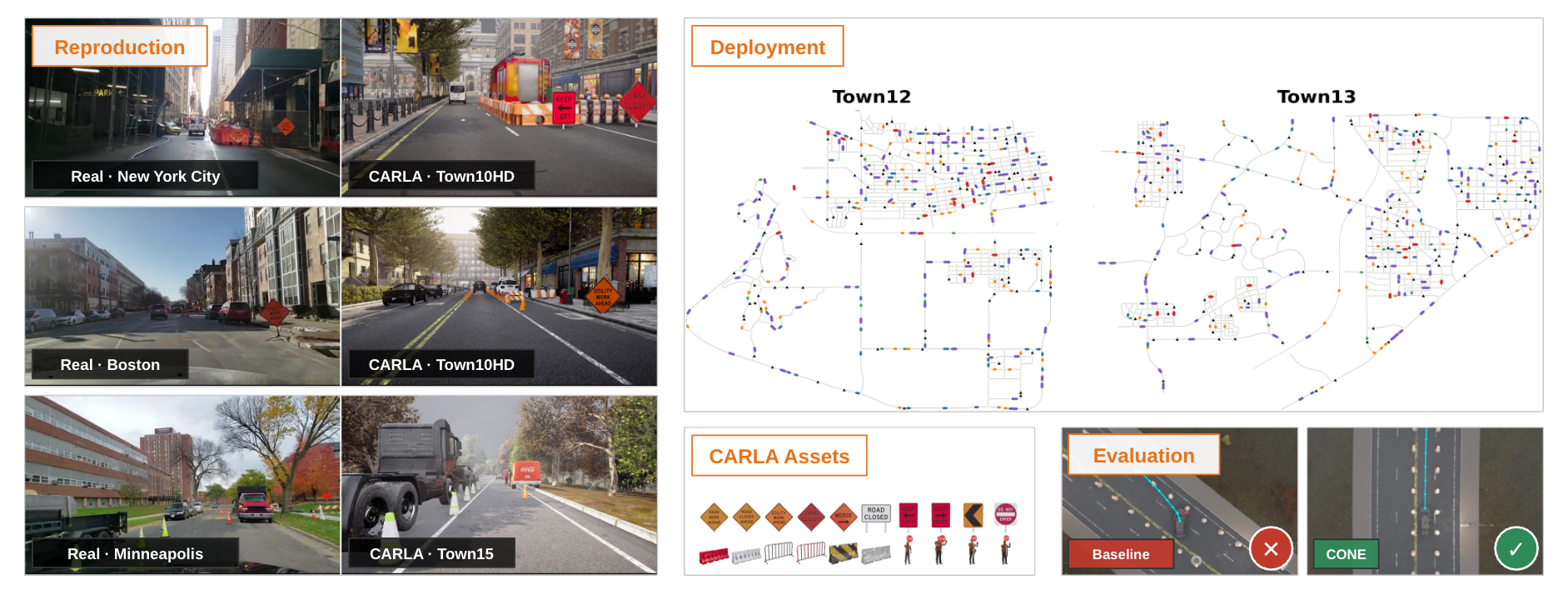
Real work zones, rebuilt in CARLA
CONE starts from real work zones. A New York street from ROADWork and the same object layout rebuilt in CARLA Town10HD, frame by frame: the same cones, drums and closed lane, now with cameras, LiDAR and a planner in the loop.
From real work zones to closed-loop tests
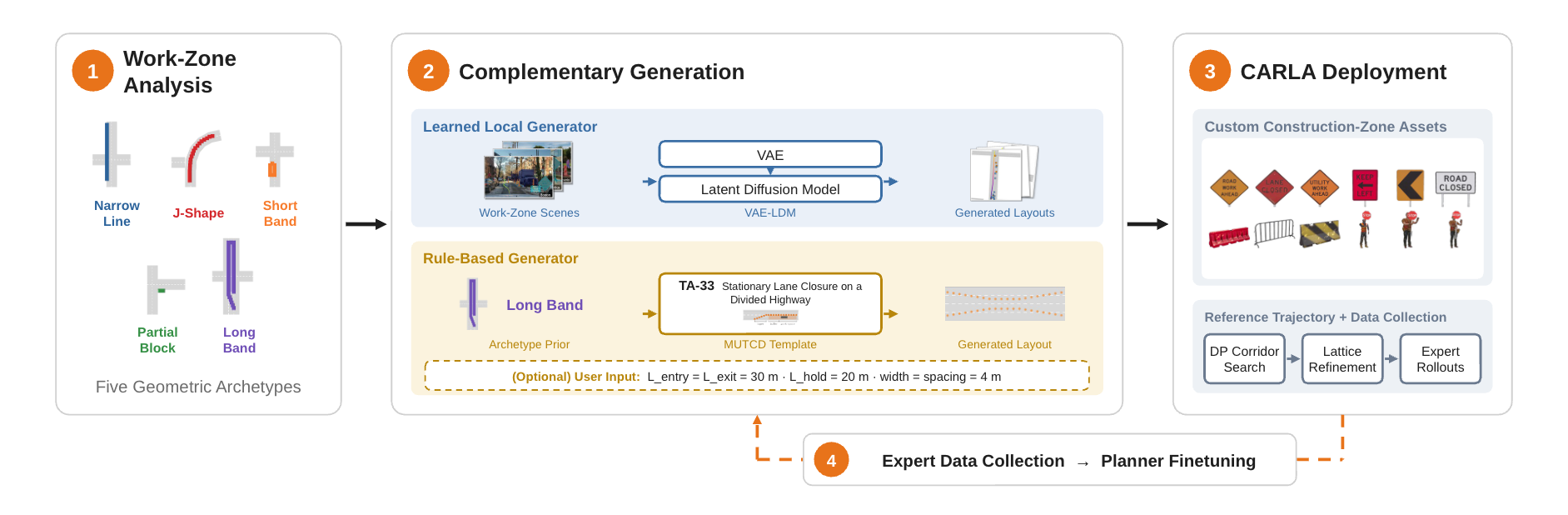
Two generators, one deployment interface, no map-specific retraining. Real work zones are analyzed into geometric archetypes, new layouts are generated, deployed in CARLA, and the resulting expert data is used to finetune a planner that is then evaluated closed-loop in the same zones.
Work-zone analysis
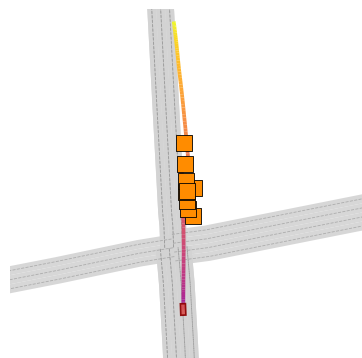
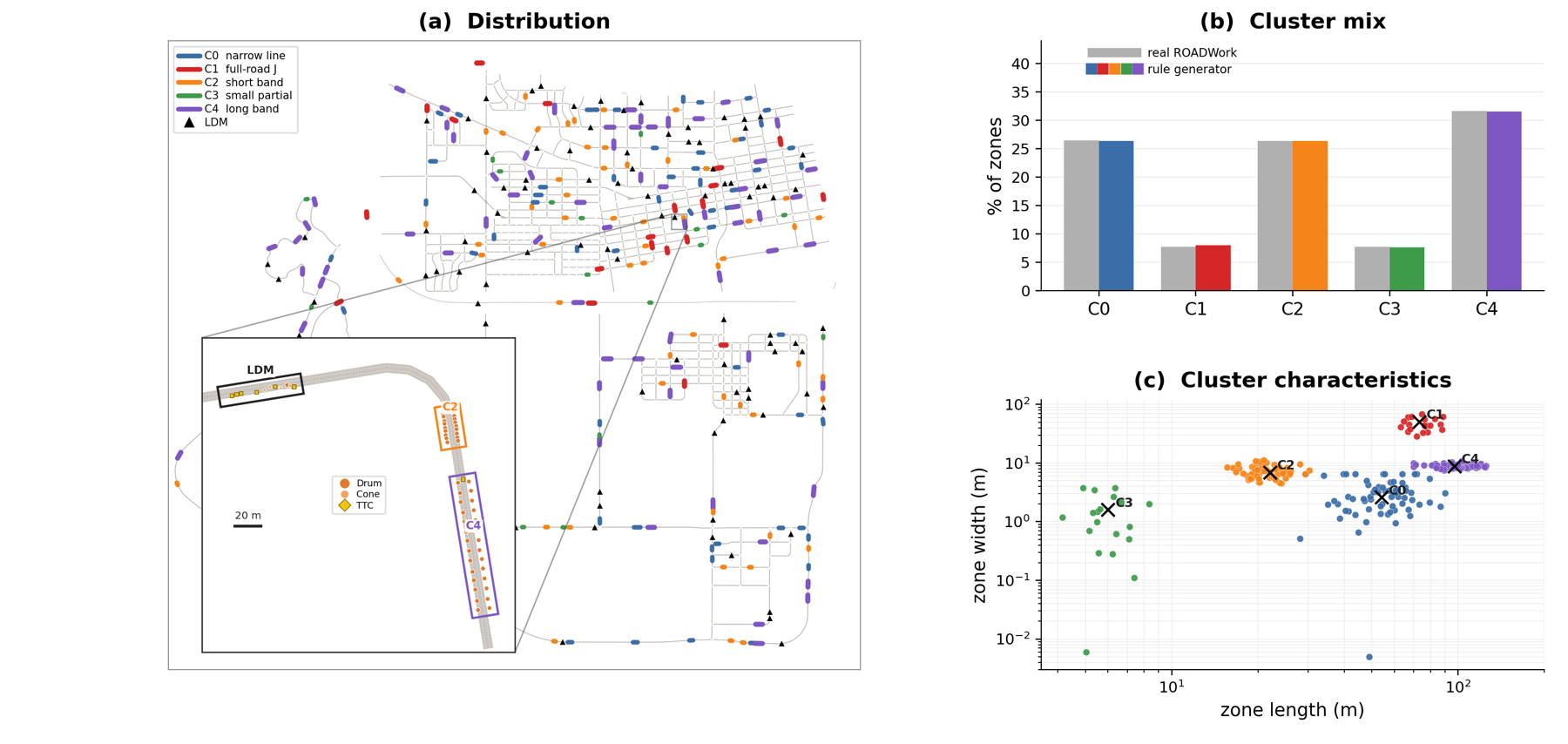
3,340 real ROADWork scenes are expressed in a road-relative Frenet frame with a 16-dimensional geometric descriptor and clustered into five archetypes.
Complementary generation
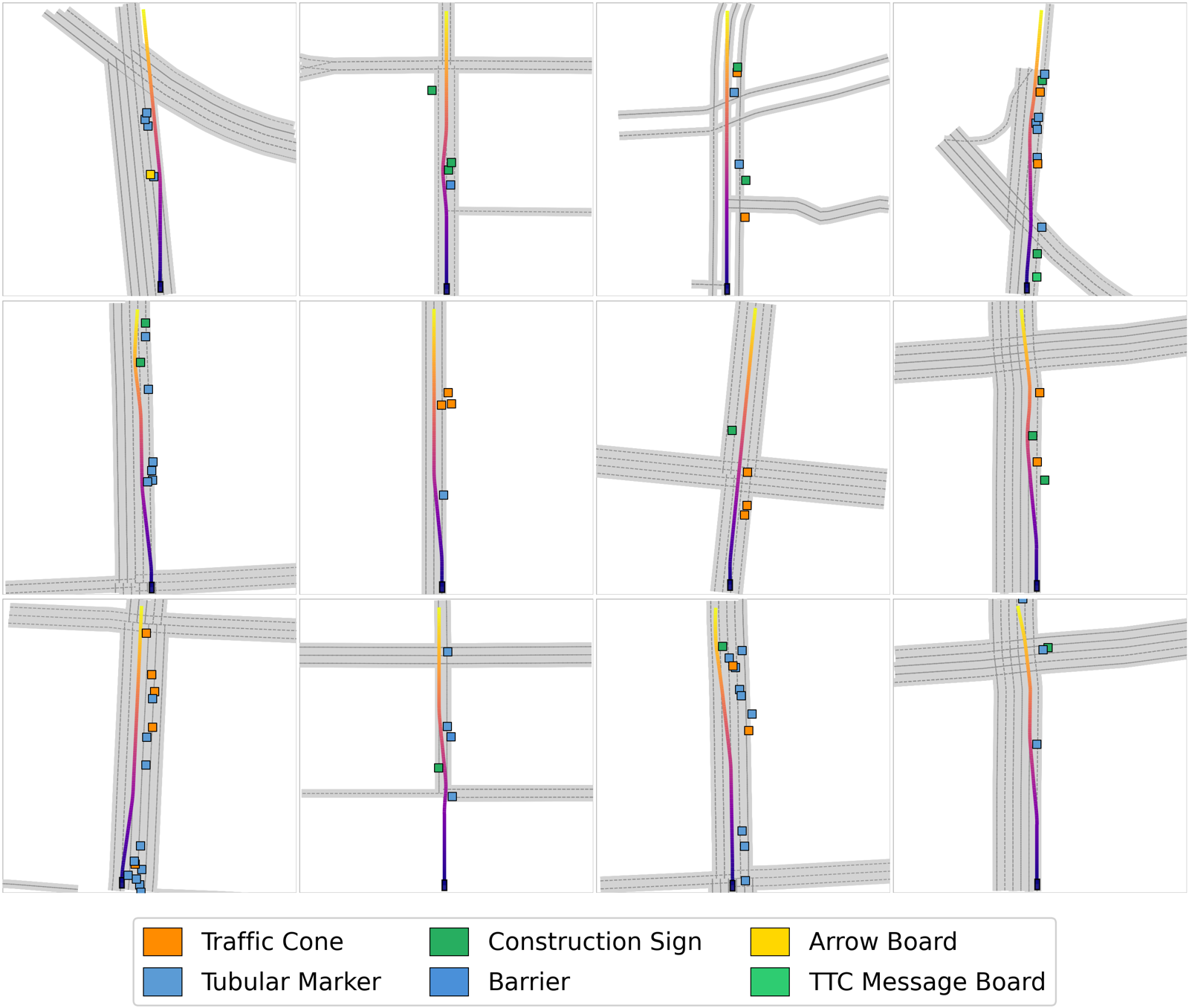
A learned VAE–LDM samples data-driven local layouts; a cluster-conditioned rule-based generator builds extended zones from archetype priors and MUTCD templates.
CARLA deployment
Layouts are instantiated with 19 custom construction assets, checked for feasible reference paths, and driven by an expert that records synchronized multi-sensor rollouts.
Closed-loop evaluation
Sensor-based planners drive the generated zones. Failures are localized by archetype, and targeted expert data finetunes the planner.
Five archetypes cover the road
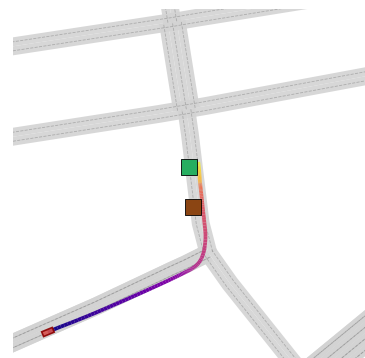
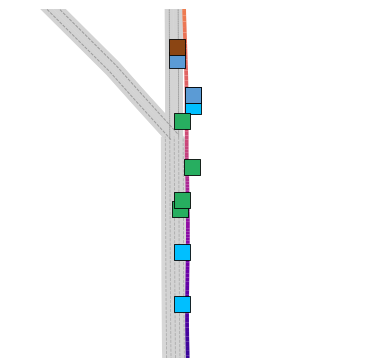
k-means over the road-relative descriptors selects k = 5 by silhouette score. The archetypes range from narrow roadside device lines and compact partial closures to intersection-scale configurations and long lane closures, and each is matched to its closest MUTCD Typical Applications.
Two complementary generators
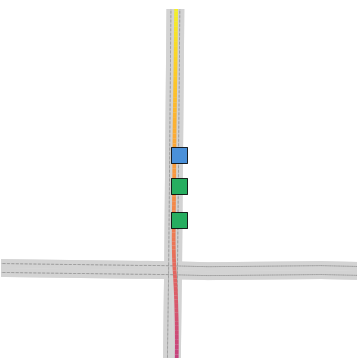
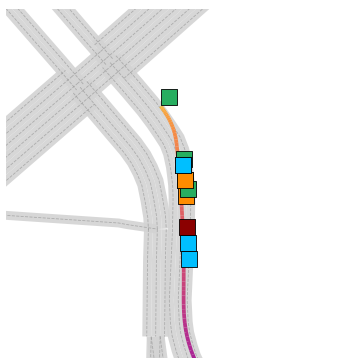
The rule-based branch builds complete, potentially extended zones by combining a compatible MUTCD template with geometric parameters sampled from the selected archetype (or set by the user: zone length, device spacing, lateral offset, taper geometry, asset type). The learned branch adapts the vectorized VAE–LDM of Scenario Dreamer to temporary traffic-control objects and captures local compositions and irregular arrangements that no template describes.
Generation fidelity and executability at 32 shared Town04 sites
| Type JSD ↓ | Spacing W1 ↓ | Valid layouts ↑ | Feasible path ↑ | CARLA deploy ↑ | |
|---|---|---|---|---|---|
| Rule-based | 0.361 | 1.28 m | 100% | 100% | 100% |
| Learned (LDM) | 0.262 | 0.88 m | 81% | 94% | 91% |
Learned layouts match the real object-type and spacing distributions more closely; rule-based validity and deployment hold by construction through on-road placement and non-intersection constraints. On log-disjoint ROADWork crops the LDM reaches 74% geometric validity versus 53% for the (annotation-noisy) real crops.
350 work zones on an unseen map
On Town12, which neither generator has seen, CONE deploys 250 rule-generated zones and 100 learned layouts, sampled at their real-world archetype frequencies at compatible road anchors. Every candidate must pass roadway-compatibility, zone-footprint non-overlap and reference-path feasibility checks.
Strong planners fail on generated lane closures
Before adaptation, two planners with distinct architectures struggle in the generated lane-closure scenarios. Both make route progress while failing to follow the temporary traffic corridor.
Collision-free construction-zone success of pretrained TFv6, with 67.9% of rollouts ending STUCK.
Construction-zone success of SimLingo despite 71.4% route completion, with 1.50 construction-asset collisions per rollout.
Stratified by archetype, TFv6 completes 83% of C0–C3 layouts collision-free but none of the C4 Long Band layouts: every rollout hits an asset, half get stuck. Extended closures that require sustained departure from the nominal lane are the hard case — so that is the family CONE targets for adaptation.
Targeted finetuning fixes the failure — and it transfers
TFv6 is finetuned for 10 epochs on 56 CONE expert rollouts (41,670 frames, 24.9% of the mixture) plus 171 original LEAD rollouts. The resulting TFv6-CONE checkpoint is evaluated under matched settings on three splits of increasing distance from the finetuning data.
Base layouts
Collision-free CZ success on the collected lane-closure family at original and held-out road locations. STUCK drops from 67.9% to 28.6% and asset collisions from 0.18 to 0 per rollout, at unchanged completion time.
Held-out variations
Unseen zone length, taper length, lateral offset, device-line curvature and asset type. STUCK falls from 83.3% to 8.7% and collisions from 1.29 to 0.13 per rollout — a transferable response to lane closures, not memorization of one layout.
Other archetypes
Structurally different Town04 layouts. Driving score rises from 26.8 to 68.1 and route completion from 50% to 100% with no STUCK outcomes, but remaining collisions show only partial transfer beyond the lane-closure family.
| Split · planner | DS ↑ | RC (%) ↑ | Coll./run ↓ | CZ success (%) ↑ | STUCK (%) ↓ |
|---|---|---|---|---|---|
| Base · SimLingo (pretrained) | 25.8 | 71.4 | 1.50 | 7.1 | 28.6 |
| Base · TFv6 (pretrained) | 25.6 | 32.1 | 0.18 | 17.9 | 67.9 |
| Base · TFv6-CONE | 71.4 | 71.4 | 0.00 | 71.4 | 28.6 |
| Held-out · TFv6 (pretrained) | 33.3 | 48.8 | 1.29 | 12.5 | 83.3 |
| Held-out · TFv6-CONE | 93.0 | 96.2 | 0.13 | 87.0 | 8.7 |
CZ success requires 100% route completion without a construction-asset collision. SimLingo uses its native route configuration and is shown as cross-architecture evidence, not a direct ranking. On 22 standard LEAD routes with background traffic and no work zones, TFv6-CONE keeps driving score essentially unchanged (89.2 vs 89.7) while route completion rises from 95.5% to 100%.
Same route, same work zone
Pretrained TFv6 on the left, TFv6-CONE on the right, each with its chase camera and BEV. Both scenarios are held-out variants never seen during finetuning.
Citation
Authors and venue will be filled in after the review period. Until then, please cite the anonymous submission.
@misc{cone_anonymous,
  title     = {Build the CONEs You Need: Work-Zone Layout Generation
               for Sensor-Rich Closed-Loop Simulation},
  author    = {Anonymous},
  note      = {Under review}
}